Ad
Ad
Ad
Tag

Hubble

Browsing

Hubble observes a changing exoplanet atmosphere at WASP-121 b

An artist impression depicting the exoplanet WASP 121-b. The planet dominates the foreground in the right side of the image, and appears banded with colours of red, yellow and orange. Behind the planet is a large star that appears similar in size to the exoplanet.
This is an artist’s impression of the exoplanet WASP 121-b, also known as Tylos. The exoplanet’s appearance is based on Hubble data of the object. Using Hubble observations, another team of scientists had previously reported the detection of heavy metals such as magnesium and iron escaping from the upper atmosphere of the ultra-hot Jupiter exoplanet, marking it as the first of such detection. The exoplanet is orbiting dangerously close to its host star, roughly 2.6% of the distance between Earth and the Sun, placing it on the verge of being ripped apart by its host star’s tidal forces. The powerful gravitational forces have altered the planet’s shape.
An international team of astronomers assembled and reprocessed Hubble observations of the exoplanet made in the years 2016, 2018 and 2019. This provided them with a unique dataset that allowed them not only to analyse the atmosphere of WASP 121-b, but also to compare the state of the exoplanet’s atmosphere across several years. They found clear evidence that the observations of WASP-121 b were varying in time. The team then used sophisticated modelling techniques to demonstrate that these temporal variations could be explained by weather patterns in the exoplanet’s atmosphere.
Credit: NASA, ESA, Q. Changeat et al., M. Zamani (ESA/Hubble)

An international team of astronomers has assembled and reprocessed observations of the exoplanet WASP-121 b that were collected with the NASA/ESA Hubble Space Telescope in the years 2016, 2018 and 2019. This provided them with a unique dataset that allowed them not only to analyse the atmosphere of WASP 121 b, but also to compare the state of the exoplanet’s atmosphere across several years. They found clear evidence that the observations of WASP-121 b were varying in time. The team then used sophisticated modelling techniques to demonstrate that these temporal variations could be explained by weather patterns in the exoplanet’s atmosphere.

Observing exoplanets — planets beyond our Solar System — is challenging, because of both their distance from Earth and the fact that they mostly orbit stars that are far bigger and brighter than the planets are. This means that astronomers who have been able to observe an exoplanet with a telescope as sophisticated as Hubble typically have to combine all their data in order to get enough information to make confident deductions about the exoplanet’s properties. By combining the observations to increase the strength of the exoplanet signal, astronomers can construct an averaged picture of its atmosphere, but this does not tell them whether it is changing. In other words, they cannot study the weather on other worlds using this averaging method. Studying weather requires far more data of high quality, taken over a wider period of time. Fortunately, Hubble has now been active for such an impressive length of time that a vast archive of Hubble data exists, sometimes with multiple sets of observations of the same celestial object — and that includes the exoplanet WASP-121 b.

WASP-121 b (also known as Tylos) is a well-studied hot Jupiter [1] that orbits a star that lies about 880 light-years from Earth, completing a full orbit in a very brisk 30-hour period. Its extremely close proximity to its host star means that it is tidally locked [2], and that the star-facing hemisphere is very hot, with temperatures exceeding 3000 Kelvins [3]. The team combined four sets of archival observations of WASP-121 b, all made using Hubble’s Wide Field Camera 3 (WFC 3). The complete assembled dataset included observations of: WASP-121 b transiting in front of its star (taken in June 2016); WASP-121 b transiting behind its star, also known as a secondary eclipse (taken in November 2016); and two phase-curves [4] of WASP-121 b (taken in March 2018 and February 2019 respectively). The team took the unique step of processing each dataset in the same way, even if it had been previously processed by a different team. Exoplanet data processing is time consuming and complicated, but nonetheless it was worth it because it allowed the team to directly compare the processed data from each set of observations with one another. One of the principal investigators of the team, Quentin Changeat, an ESA Research Fellow at the Space Telescope Science Institute, elaborates:

“Our dataset represents a significant amount of observing time for a single planet and is currently the only consistent set of such repeated observations. The information that we extracted from those observations was used to characterise (infer the chemistry, temperature, and clouds) of the atmosphere of WASP-121 b at different times. This provided us with an exquisite picture of the planet, changing in time.”

After cleaning each dataset, the team found clear evidence that the observations of WASP-121 b were varying in time. While instrumental effects could remain, the data showed an apparent shift in the exoplanet’s hot spot [5] and differences in spectral signature (which signifies the chemical composition of the exoplanet’s atmosphere) indicative of a changing atmosphere. Next, the team used highly sophisticated computational models to attempt to understand observed behaviour of the exoplanet’s atmosphere. The models indicated that their results could be explained by quasi-periodic weather patterns, specifically massive cyclones that are repeatedly created and destroyed as a result of the huge temperature difference between the star-facing and dark side of the exoplanet. This result represents a significant step forward in potentially observing weather patterns on exoplanets.

“The high resolution of our exoplanet atmosphere simulations allows us to accurately model the weather on ultra-hot planets like WASP-121 b,” explained Jack Skinner, a postdoctoral fellow at the California Institute of Technology and co-leader of this study. “Here we make a significant step forward by combining observational constraints with atmosphere simulations to understand the time-varying weather on these planets.”

“Weather on Earth is responsible for many aspects of our life, and in fact the long-term stability of Earth’s climate and its weather is likely the reason why life could emerge in the first place,” added Changeat. “Studying exoplanets’ weather is vital to understanding the complexity of exoplanet atmospheres, especially in our search for exoplanets with habitable conditions.”

Future observations with Hubble and other powerful telescopes, including Webb, will provide greater insight into weather patterns on distant worlds: and ultimately, possibly to finding exoplanets with stable long-term climates and weather patterns.

Notes

[1] Hot Jupiters are a type of exoplanet with no direct Solar System analogue: they are inflated gas giants that orbit very close to their parent stars, often performing a complete orbit in a matter of a few days.

[2] Tidal locking refers to the situation where an orbiting body always presents the same hemisphere to the object that it orbits. For example, the Moon is tidally locked to Earth, which explains why the surface of the Moon always looks the same from our perspective here on Earth. In some cases, the two bodies might be tidally locked to one another, although this is not the case for the Moon and Earth: from the perspective of an astronaut on the Moon, Earth still appears to rotate on its own axis. Tidally locked planets will have an extremely uneven temperature distribution across their entire surface, with the star-facing hemisphere much hotter than the other.

[3] Kelvins (K) are the unit of temperature typically used by many scientists, including astronomers. Kelvins are the same in size as degrees Celsius (℃), however, the Kelvin scale is offset from the Celsius scale, which is set to zero at the freezing point of water at one atmosphere of pressure. In contrast, zero on the Kelvin scale is known as absolute zero, and is thought to be the lowest temperature possible, where all kinetic activity of all molecules ceases. 0 K is equivalent to –273.15 ℃.

[4] Exoplanet phase curves show the varying amount of light received from a star-exoplanet system as the exoplanet orbits its parent star.

[5] Exoplanet hot spots are, as the name suggests, the hottest spots on the exoplanet’s surface. Whilst it would be intuitive to suppose that the hotspot will always be at the point on the planet closest to the star, in fact many studies have shown that exoplanet hotspots are frequently offset. This may be due to wind or other atmospheric patterns on the exoplanets themselves.

Link to the Science paper

Press release from ESA Hubble.
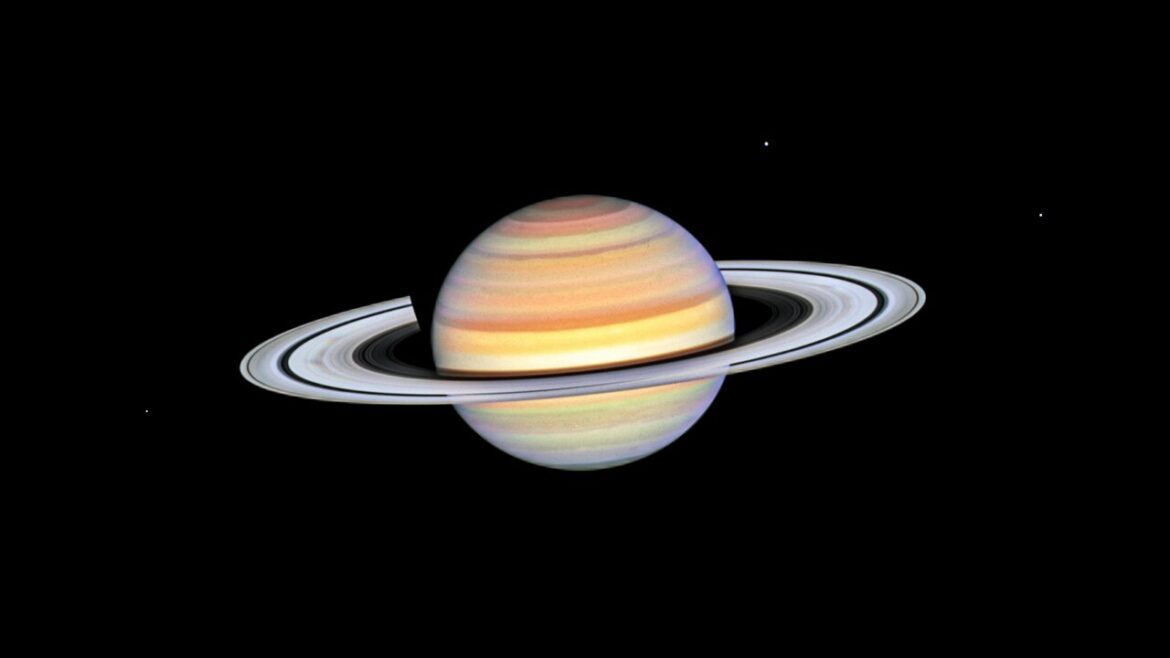
Hubble watches spoke season on Saturn

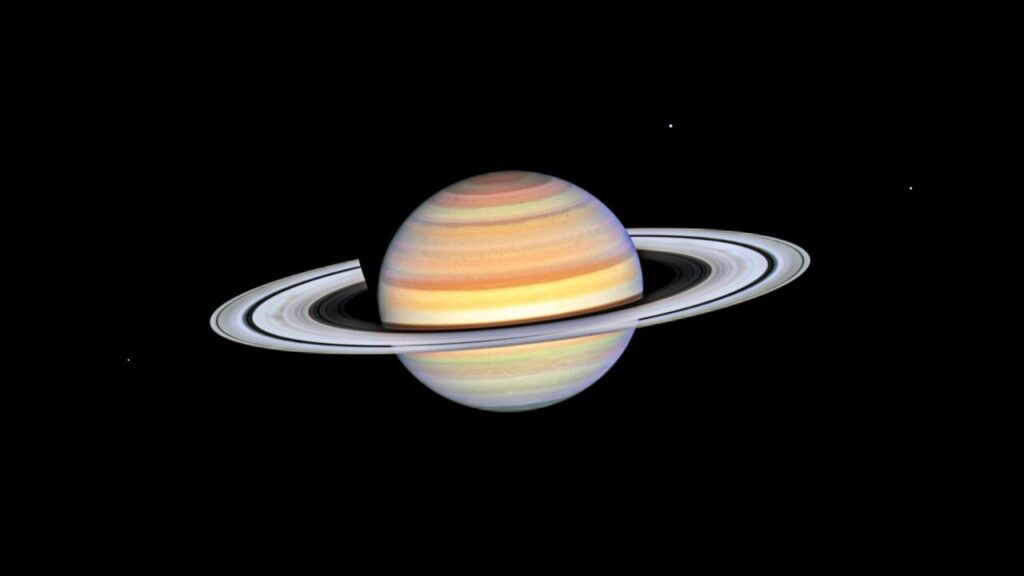
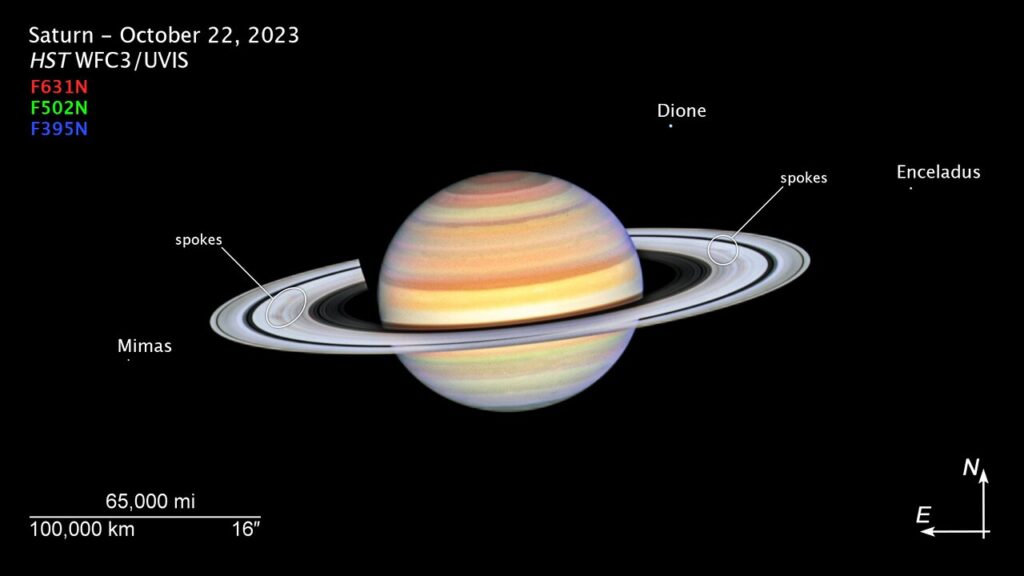
Planet Saturn with bright white rings, multi-colored main sphere, and moons Mimas, Dione, and Enceladus. Spoke features on the left and right sides of the rings appear like faint grey smudges against the rings’ bright backdrop, about midway from the planet to the rings’ outer edge. Above the rings plane, the planet’s bands are shades of red, orange and yellow, with bright white nearer the equator.
This photo of Saturn was taken by the NASA/ESA Hubble Space Telescope on 22 October 2023, when the ringed planet was approximately 1365 million kilometres from Earth. Hubble’s ultra-sharp vision reveals a phenomenon called ring spokes.
Saturn’s spokes are transient features that rotate along with the rings. Their ghostly appearance only persists for two or three rotations around Saturn. During active periods, freshly-formed spokes continuously add to the pattern.
In 1981, NASA’s Voyager 2 first photographed the ring spokes. Hubble continues observing Saturn annually as the spokes come and go. This cycle has been captured by Hubble’s Outer Planets Atmospheres Legacy (OPAL) program that began nearly a decade ago to annually monitor weather changes on all four gas-giant outer planets.
Hubble’s crisp images show that the frequency of spoke apparitions is seasonally driven, first appearing in OPAL data in 2021 but only on the morning (left) side of the rings. Long-term monitoring shows that both the number and contrast of the spokes vary with Saturn’s seasons. Saturn is tilted on its axis like Earth and has seasons lasting approximately seven years.
This year, these ephemeral structures appear on both sides of the planet simultaneously as they spin around the giant world. Although they look small compared with Saturn, their length and width can stretch longer than Earth’s diameter!
The OPAL team notes that the leading theory is that spokes are tied to interactions between Saturn’s powerful magnetic field and the sun. Planetary scientists think that electrostatic forces generated from this interaction levitate dust or ice above the ring to form the spokes, though after several decades no theory perfectly predicts the spokes. Continued Hubble observations may eventually help solve the mystery.
Credit: Credit: NASA, ESA, STScI, A. Simon (NASA-GSFC)

This photo of Saturn was taken by the NASA/ESA Hubble Space Telescope on 22 October 2023, when the ringed planet was approximately 1365 million kilometres from Earth. Hubble’s ultra-sharp vision reveals a phenomenon called ring spokes.

Saturn’s spokes are transient features that rotate along with the rings. Their ghostly appearance only persists for two or three rotations around Saturn. During active periods, freshly-formed spokes continuously add to the pattern.

In 1981, NASA’s Voyager 2 first photographed the ring spokes. Hubble continues observing Saturn annually as the spokes come and go. This cycle has been captured by Hubble’s Outer Planets Atmospheres Legacy (OPAL) program that began nearly a decade ago to annually monitor weather changes on all four gas-giant outer planets.

Hubble’s crisp images show that the frequency of spoke apparitions is seasonally driven, first appearing in OPAL data in 2021 but only on the morning (left) side of the rings. Long-term monitoring shows that both the number and contrast of the spokes vary with Saturn’s seasons. Saturn is tilted on its axis like Earth and has seasons lasting approximately seven years.

This year, these ephemeral structures appear on both sides of the planet simultaneously as they spin around the giant world. Although they look small compared with Saturn, their length and width can stretch longer than Earth’s diameter!

The OPAL team notes that the leading theory is that spokes are tied to interactions between Saturn’s powerful magnetic field and the sun. Planetary scientists think that electrostatic forces generated from this interaction levitate dust or ice above the ring to form the spokes, though after several decades no theory perfectly predicts the spokes. Continued Hubble observations may eventually help solve the mystery. This image was created with Hubble data from proposal 16995 (A. Simon).

Planet Saturn with bright white rings, multi-colored main sphere, and moons Mimas, Dione, and Enceladus. Spoke features on the left and right sides of the rings appear like faint grey smudges against the rings’ bright backdrop, about midway from the planet to the rings’ outer edge. Above the rings plane, the planet’s bands are shades of red, orange and yellow, with bright white nearer the equator.
This photo of Saturn was taken by the NASA/ESA Hubble Space Telescope on 22 October 2023, when the ringed planet was approximately 1365 million kilometres from Earth. Hubble’s ultra-sharp vision reveals a phenomenon called ring spokes.
Saturn’s spokes are transient features that rotate along with the rings. Their ghostly appearance only persists for two or three rotations around Saturn. During active periods, freshly-formed spokes continuously add to the pattern.
In 1981, NASA’s Voyager 2 first photographed the ring spokes. Hubble continues observing Saturn annually as the spokes come and go. This cycle has been captured by Hubble’s Outer Planets Atmospheres Legacy (OPAL) program that began nearly a decade ago to annually monitor weather changes on all four gas-giant outer planets.
Hubble’s crisp images show that the frequency of spoke apparitions is seasonally driven, first appearing in OPAL data in 2021 but only on the morning (left) side of the rings. Long-term monitoring shows that both the number and contrast of the spokes vary with Saturn’s seasons. Saturn is tilted on its axis like Earth and has seasons lasting approximately seven years.
This year, these ephemeral structures appear on both sides of the planet simultaneously as they spin around the giant world. Although they look small compared with Saturn, their length and width can stretch longer than Earth’s diameter!
The OPAL team notes that the leading theory is that spokes are tied to interactions between Saturn’s powerful magnetic field and the sun. Planetary scientists think that electrostatic forces generated from this interaction levitate dust or ice above the ring to form the spokes, though after several decades no theory perfectly predicts the spokes. Continued Hubble observations may eventually help solve the mystery.
Credit: NASA, ESA, STScI, A. Simon (NASA-GSFC)


Press release from ESA Hubble.

A holiday globe of stars from UGC 8091

To celebrate the holiday season, the NASA/ESA Hubble Space Telescope has captured the galaxy known as UGC 8091, which resembles a sparkling festive snow globe. With a dazzling array of wavelengths of light captured by filters on Hubble’s premier scientific instruments, the millions of stars in this galaxy are being explored in more depth than ever before.

A collection of stars and galaxies fill the scene against a dark background. The image is dominated by a dense collection of stars that make up the irregular galaxy UGC 8091. The stars span a variety of colours, including blue and orange, with patches of blue occupying the central part of the galaxy. There are also visible circular regions of red/pink gas within the galaxy.

UGC 8091, also known as GR 8, lies around seven million light-years from Earth in the constellation Virgo. Unlike other galaxies whose stars take a more orderly appearance, UGC 8091 is classed by astronomers as an irregular galaxy. It’s not hard to see why — the stars that make up this celestial gathering look more like a brightly shining tangle of string lights than a galaxy. Some irregular galaxies are thought to have become tangled by tumultuous internal activity, while others are known to have formed by interactions with neighbouring galaxies. The result is a class of galaxies with a diverse array of sizes and shapes, including the diffuse scatter of stars that is this galaxy.

In particular, UGC 8091 is a dwarf irregular galaxy, meaning that it only contains around one billion stars. That’s a huge number of lights, but not for a galaxy: our own Milky Way galaxy is thought to encompass over 100 billion stars, and other galaxies can have trillions! Dwarf galaxies often orbit larger galaxies, and their low masses leave them vulnerable to being disturbed and consumed by their bigger neighbours, a process which produces twisted-up dwarf irregulars like UGC 8091.This type of galaxy is thought to have similar characteristics to the enormously old and distant galaxies seen by astronomers in deep-field images. It’s hoped that investigating the composition of dwarf galaxies and their stars, particularly their low metallicity [1], will help to uncover the evolutionary links between these ancient galaxies and more modern galaxies like our own.

To do this, astronomers have been carefully examining the many-coloured stars of UGC 8091. Different features of the galaxy can be picked out by using filters to restrict the light entering Hubble’s instruments to very specific wavelength ranges. Those filtered images can then be recombined to make a full-colour image — an astonishing twelve filters combine to produce this image, with light from the mid-ultraviolet right through to the red end of the visible spectrum contributing. The blossoming patches of red represent light emitted by excited hydrogen molecules in hot, energetic stars that have formed in recent starbursts. The other sparkles on show in this image are a mix of older stars.

The data used in this image date from 2006 to 2021, and were taken by two of Hubble’s most advanced instruments: the Wide Field Camera 3 and the Advanced Camera for Surveys. Among other things, the observing programmes sought to investigate the role of low-mass galaxies, like UGC 8091, in reionising the early Universe, and to examine the results of star formation in low-metallicity galaxies. Despite how small and misshapen they look, dwarf irregular galaxies turn out to hold a great deal of information about our Universe — no less than any of the other celestial lights in our sky.

 A collection of stars and galaxies fill the scene against a dark background. The image is dominated by a dense collection of stars that make up the irregular galaxy UGC 8091. The stars span a variety of colours, including blue and orange, with patches of blue occupying the central part of the galaxy. There are also visible circular regions of red/pink gas within the galaxy.
For the end of the year and the holiday season Hubble has captured the festive bundle of lights known as UGC 8091. UGC 8091, also known as GR 8, lies around seven million light-years from Earth in the constellation Virgo. It is a dwarf irregular galaxy: a comparatively small, low-mass galaxy without a distinct or uniform shape.
The filters used in this image date from 2006 up to 2021, and were taken by two of Hubble’s most advanced instruments: the Wide Field Camera 3 and the Advanced Camera for Surveys. An astonishing twelve filters combine to produce this image, with light from the mid-ultraviolet right through to the red end of the visible spectrum contributing. The blossoming patches of red represent light emitted by excited hydrogen molecules in hot, energetic stars that have formed in recent starbursts. The other glittering lights on show are a mix of older stars.
Credit: ESA/Hubble, NASA Y. Choi (NOIRLab), K. Gilbert (Space Telescope Science Institute), J. Dalcanton (Flatiron Institute and University of Washington)

Notes

[1] Metallicity is a measure of how much of a star is made up of elements heavier than helium and hydrogen. Such elements are made in the cores of stars, so the first generation of stars in the Universe would have had low metallicity, since there had been no previous stars to make heavier elements. Many dwarf galaxies contain stars with a low level of metallicity.


Press release from ESA Hubble

Researchers stunned by Webb’s new high-definition look at an exploded star, the Cassiopeia A supernova remnant

Like a shiny, round ornament ready to be placed in the perfect spot on the holiday tree, supernova remnant Cassiopeia A (Cas A) gleams in a new image from the NASA/ESA/CSA James Webb Space Telescope. However, this scene is no proverbial silent night — all is not calm.

A roughly circular cloud of gas and dust with complex structure. The inner shell is made of bright pink and orange filaments studded with clumps and knots that look like tiny pieces of shattered glass. Around the exterior of the inner shell, there are curtains of wispy gas that look like campfire smoke. Around and within the nebula, various stars are seen as points of blue and white light. Outside the nebula, there are also clumps of dust, coloured yellow in the image.
A new high-definition image from the NASA/ESA/CSA James Webb Space Telescope’s NIRCam (Near-Infrared Camera) unveils intricate details of supernova remnant Cassiopeia A (Cas A), and shows the expanding shell of material slamming into the gas shed by the star before it exploded.
The most noticeable colours in Webb’s newest image are clumps of bright orange and light pink that make up the inner shell of the supernova remnant. These tiny knots of gas, composed of sulphur, oxygen, argon, and neon from the star itself, are only detectable thanks to NIRCam’s exquisite resolution, and give researchers a hint at how the dying star shattered like glass when it exploded.
The outskirts of the main inner shell look like smoke from a campfire. This marks where ejected material from the exploded star is ramming into surrounding circumstellar material. Researchers have concluded that this white colour is light from synchrotron radiation, which is generated by charged particles travelling at extremely high speeds and spiralling around magnetic field lines.
There are also several light echoes visible in this image, most notably in the bottom right corner. This is where light from the star’s long-ago explosion has reached, and is warming, distant dust, which glows as it cools down.
Credit: NASA, ESA, CSA, STScI, D. Milisavljevic (Purdue University), T. Temim (Princeton University), I. De Looze (University of Gent)

Webb’s NIRCam (Near-Infrared Camera) view of Cas A displays a very violent explosion at a resolution previously unreachable at these wavelengths. This high-resolution look unveils intricate details of the expanding shell of material slamming into the gas shed by the star before it exploded.

Cas A is one of the best-studied supernova remnants in all the cosmos. Over the years, ground-based and space-based observatories, including the NASA/ESA Hubble Space Telescope, have collectively assembled a multiwavelength picture of the object’s tattered remains.

However, astronomers have now entered a new era in the study of Cas A. In April 2023, Webb’s MIRI (Mid-Infrared Instrument) started this story, revealing new and unexpected features within the inner shell of the supernova remnant. But many of those features are invisible in the new NIRCam image, and astronomers are investigating why that is.

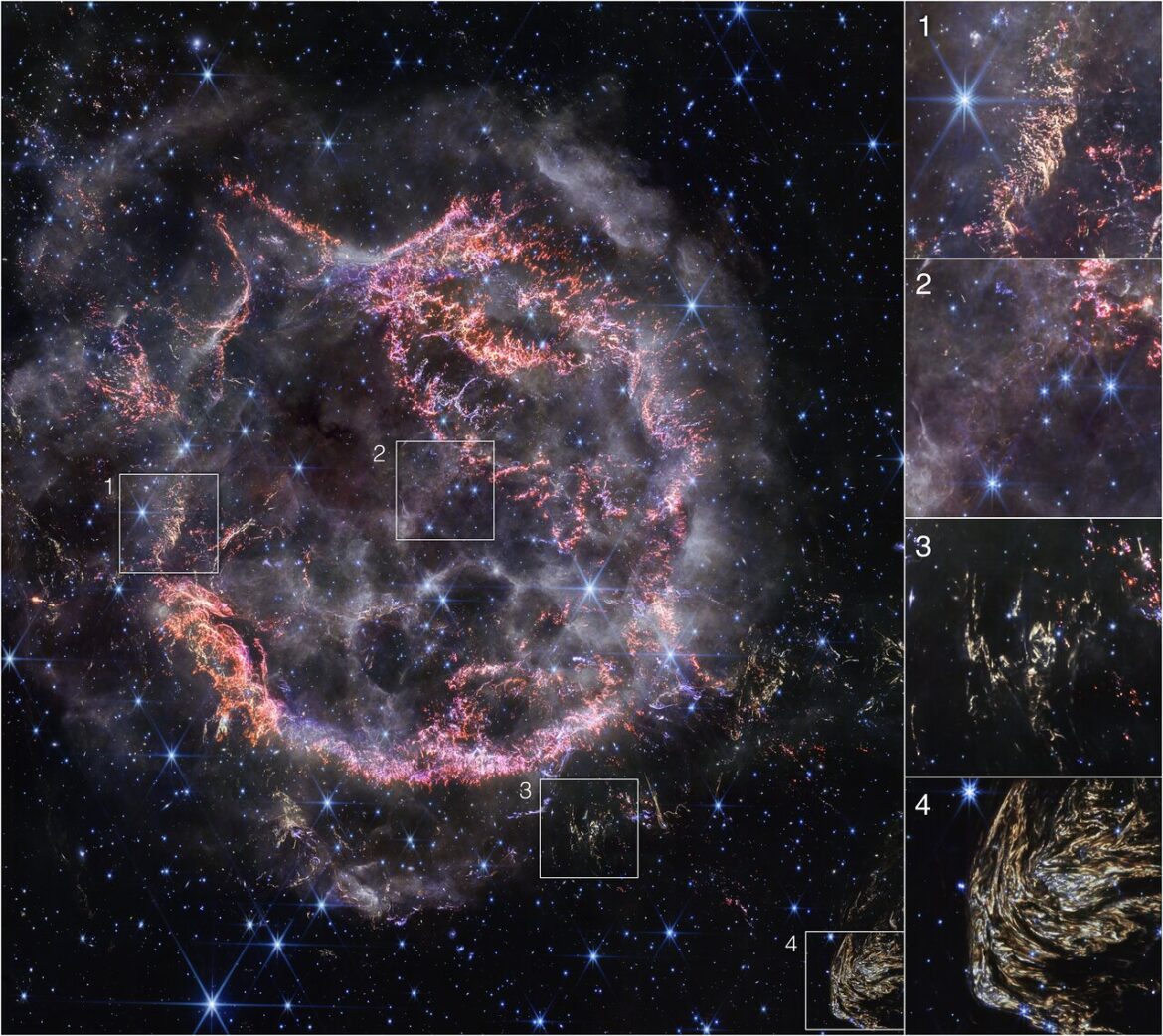
The image is split into five boxes. A large image at the left-hand side takes up most of the image. There are four images along the right-hand side in a column, which show zoomed-in areas of the larger square image on the left. The image on the left shows a roughly circular cloud of gas and dust with a complex structure, with an inner shell of bright pink and orange filaments that look like tiny pieces of shattered glass. A zoom-in of this material appears in the box labelled 1. Around the exterior of the inner shell in the main image there are wispy curtains of gas that look like campfire smoke. Box 2 is a zoom-in on these circles. Scattered outside the nebula in the main image are clumps of dust, coloured yellow in the image. Boxes 3 and 4 are zoomed-in areas of these clumps. Box 4 highlights a particularly large clump at the bottom right of the main image that is detailed and striated.
This image highlights several interesting features of the supernova remnant Cassiopeia A (Cas A), as seen with Webb’s NIRCam (Near-Infrared Camera).
NIRCam’s exquisite resolution is able to detect tiny knots of gas, composed of sulphur, oxygen, argon, and neon from the star itself. Some filaments of debris are too tiny to be resolved, even by Webb, meaning that they are comparable to or less than 16 billion kilometres across (around 100 astronomical units). Researchers consider that this represents how the star shattered like glass when it exploded.
Circular holes visible in the MIRI image within the Green Monster, a loop of green light in Cas A’s inner cavity, are faintly outlined in white and purple emission in the NIRCam image — this represents ionised gas. Researchers believe this is due to the supernova debris pushing through and sculpting gas left behind by the star before it exploded.
This is one of a few light echoes visible in NIRCam’s image of Cas A. A light echo occurs when light from the star’s long-ago explosion has reached, and is warming, distant dust, which glows as it cools down.
NIRCam captured a particularly intricate and large light echo, nicknamed Baby Cas A by researchers. It is actually located about 170 light-years behind the supernova remnant.
Credit: NASA, ESA, CSA, STScI, D. Milisavljevic (Purdue University), T. Temim (Princeton University), I. De Looze (University of Gent)

Infrared light is invisible to our eyes, so image processors and scientists represent these wavelengths of light with visible colours. In this newest image of Cas A, colours were assigned to NIRCam’s different filters, and each of those colours hints at different activity occurring within the object.

At first glance, the NIRCam image may appear less colourful than the MIRI image. However, this does not mean there is less information: it simply comes down to the wavelengths in which the material in the object is emitting its light.

A comparison between two images, one on the left (labelled NIRCam), and on the right (labelled MIRI), separated by a white line. On the left, the image is of a roughly circular cloud of gas and dust with a complex structure. The inner shell is made of bright pink and orange filaments that look like tiny pieces of shattered glass. Around the exterior of the inner shell are curtains of wispy gas that look like campfire smoke. On the right is the same nebula seen in different light. The curtains of material outside the inner shell glow orange instead of white. The inner shell looks more mottled, and is a muted pink. At centre right, a greenish loop extends from the right side of the ring into the central cavity.
This image provides a side-by-side comparison of supernova remnant Cassiopeia A (Cas A) as captured by the NASA/ESA/CSA James Webb Space Telescope’s NIRCam (Near-Infrared Camera) and MIRI (Mid-Infrared Instrument).
At first glance, Webb’s NIRCam image appears less colourful than the MIRI image. But this is only because the material from the object is emitting light at many different wavelengths The NIRCam image appears a bit sharper than the MIRI image because of its greater resolution.
The outskirts of the main inner shell, which appeared as a deep orange and red in the MIRI image, look like smoke from a campfire in the NIRCam image. This marks where the supernova blast wave is ramming into surrounding circumstellar material. The dust in the circumstellar material is too cool to be detected directly at near-infrared wavelengths, but lights up in the mid-infrared.
Also not seen in the near-infrared view is the loop of green light in the central cavity of Cas A that glowed in mid-infrared light, nicknamed the Green Monster by the research team. The circular holes visible in the MIRI image within the Green Monster, however, are faintly outlined in white and purple emission in the NIRCam image.
Credit: NASA, ESA, CSA, STScI, D. Milisavljevic (Purdue University), T. Temim (Princeton University), I. De Looze (University of Gent)

The most noticeable colours in Webb’s newest image are clumps of bright orange and light pink that make up the inner shell of the supernova remnant. Webb’s razor-sharp view can detect the tiniest knots of gas, composed of sulphur, oxygen, argon, and neon from the star itself. Embedded in this gas is a mixture of dust and molecules, which will eventually be incorporated into new stars and planetary systems. Some filaments of debris are too tiny to be resolved, even by Webb, meaning that they are comparable to or less than 16 billion kilometres across (around 100 astronomical units). In comparison, the entirety of Cas A spans 10 light-years, or roughly 96 trillion kilometres.

When comparing Webb’s new near-infrared view of Cas A with the mid-infrared view, its inner cavity and outermost shell are curiously devoid of colour. The outskirts of the main inner shell, which appeared as a deep orange and red in the MIRI image, now look like smoke from a campfire. This marks where the supernova blast wave is ramming into the surrounding circumstellar material. The dust in the circumstellar material is too cool to be detected directly at near-infrared wavelengths, but lights up in the mid-infrared.

Researchers have concluded that the white colour is light from synchrotron radiation, which is emitted across the electromagnetic spectrum, including the near-infrared. It’s generated by charged particles travelling at extremely high speeds and spiralling around magnetic field lines. Synchrotron radiation is also visible in the bubble-like shells in the lower half of the inner cavity.

Also not seen in the near-infrared view is the loop of green light in the central cavity of Cas A that glowed in mid-infrared light, appropriately nicknamed the Green Monster by the research team. This feature was described as ‘challenging to understand’ by researchers at the time of their first look.

While the ‘green’ of the Green Monster is not visible in NIRCam, what’s left over in the near-infrared in that region can provide insight into the mysterious feature. The circular holes visible in the MIRI image are faintly outlined in white and purple emission in the NIRCam image — this represents ionised gas. Researchers believe this is due to the supernova debris pushing through and sculpting gas left behind by the star before it exploded.

Researchers were also absolutely stunned by one fascinating feature at the bottom right corner of NIRCam’s field of view. They’re calling that large, striated blob Baby Cas A — because it appears like an offspring of the main supernova.

This is a light echo. Light from the star’s long-ago explosion has reached, and is warming, distant dust, which glows as it cools down. The intricacy of the dust pattern, and Baby Cas A’s apparent proximity to Cas A itself, are particularly intriguing to researchers. In actuality, Baby Cas A is located about 170 light-years behind the supernova remnant.

There are also several other, smaller light echoes scattered throughout Webb’s new portrait.

The Cas A supernova remnant is located 11 000 light-years away in the constellation Cassiopeia. It’s estimated to have exploded about 340 years ago from our point of view.

The image shows a roughly circular cloud of gas and dust with a complex structure. At lower left, a white arrow pointing in the 2 o’clock direction is labelled N for north, while an arrow pointing in the 10 o‘clock direction is labelled E for east. At lower right, a scale bar is labelled 3 light-years and 1 arcminute. At the bottom is a list of MIRI filters in different colours, from left to right: F162M (blue), F356W (green), and F444W (red).
This image of the Cassiopeia A supernova remnant, captured by Webb’s NIRCam (Near-Infrared Camera) shows compass arrows, a scale bar, and a colour key for reference.
The north and east compass arrows show the orientation of the image on the sky.
The scale bar is labeled in light-years, which is the distance that light travels in one Earth-year (it takes 3 years for light to travel a distance equal to the length of the scale bar). One light-year is equal to about 9.46 trillion kilometers.
This image shows invisible near-infrared wavelengths of light that are represented by visible-light colours. The colour key shows which NIRCam filters were used when collecting the light. The colour of each filter name is the visible-light colour used to represent the infrared light that passes through that filter.
Credit: NASA, ESA, CSA, STScI, D. Milisavljevic (Purdue University), T. Temim (Princeton University), I. De Looze (University of Gent)

Press release from ESA Webb.

Hubble measures the size of LTT 1445Ac, the nearest transiting Earth-sized planet

The NASA/ESA Hubble Space Telescope has measured the size of LTT 1445Ac, the nearest Earth-sized exoplanet that passes across the face of a neighbouring star. This alignment, called a transit, opens the door to follow-on studies to see what kind of atmosphere, if any, the rocky world might have.

[Image description: This is an artist’s concept of nearby exoplanet LTT 1445Ac, which appears as a large whitish-orange disk at lower left. The rocky planet orbits a red dwarf star which is a bright red sphere in the image centre. The star is in a triple system, with two closely orbiting red dwarfs – a pair of red dots – seen at upper right.]
This is an artist’s concept of the nearby exoplanet, LTT 1445Ac, which is the size of Earth. The planet orbits a red dwarf star. The star is in a triple system, with two closely orbiting red dwarfs seen at upper right. The black dot in front of the foreground star is planet LTT 1445Ab, transiting the face of the star. Exoplanet LTT 1445Ac has a surface temperature of roughly 500 degrees Fahrenheit. The view is from 22 light-years away, looking back toward our Sun, which is the bright dot at lower right. Some of the background stars are part of the constellation Boötes.
Credit: NASA, ESA, L. Hustak (STScI)
The diminutive planet, LTT 1445Ac, was first discovered by NASA’s Transiting Exoplanet Survey Satellite in 2022. But the geometry of the planet’s orbital plane relative to its star as seen from Earth was uncertain because TESS does not have the required optical resolution. This means the detection could have been a so-called grazing transit, where a planet only skims across a small portion of the parent star’s disk. This would yield an inaccurate lower limit of the planet’s diameter.

“There was a chance that this system has an unlucky geometry and if that’s the case, we wouldn’t measure the right size. But with Hubble’s capabilities we nailed its diameter,” said Emily Pass of the Harvard-Smithsonian Center for Astrophysics in Cambridge, Massachusetts.

Hubble observations show that the planet makes a normal transit fully across the star’s disk, yielding a true size of only 1.07 times Earth’s diameter. This means the planet is a rocky world, like Earth, with approximately the same surface gravity. But at a surface temperature of roughly 260 degrees Celsius, it is too hot for life as we know it.

[Image description: A red giant star is in the centre of the image. An exoplanet passing in front of the star (called a transit) is shown in silhouette in a number of steps from left to right. A similar linear trajectory is shown at the bottom of the image. It is called a grazing transit rather than a full transit because it just clips the bottom of the star. This is considered a less accurate observing geometry in estimating the planet’s size. Hubble’s accuracy can distinguish between these two scenarios, yielding a precise measurement of the planet’s diameter.]
This diagram compares two scenarios for how an Earth-sized exoplanet is passing in front of its host star. The bottom path shows the planet just grazing the star. Studying the light from such a transit could lead to an inaccurate estimate of the planet’s size, making it seem smaller than it really is. The top path shows the optimum geometry, where the planet transits the full disk of the star. Hubble Space Telescope’s accuracy can distinguish between these two scenarios, yielding a precise measurement of the planet’s diameter.
Credit: NASA, ESA, E. Wheatley (STScI)
The planet orbits the star LTT 1445A, which is part of a triple system of three red dwarf stars that is 22 light-years away in the constellation Eridanus. The star has two other reported planets that are larger than LTT 1445Ac. A tight pair of two other dwarf stars, LTT 1445B and C, lies about 4.7 billion kilometres away from LTT 1445A, also resolved by Hubble. The alignment of the three stars and the edge-on orbit of the BC pair suggests that everything in the system is coplanar, including the known planets.

“Transiting planets are exciting since we can characterise their atmospheres with spectroscopy, not only with Hubble but also with the James Webb Space Telescope. Our measurement is important because it tells us that this is likely a very nearby terrestrial planet. We are looking forward to follow-on observations that will allow us to better understand the diversity of planets around other stars,” said Pass.

“Hubble remains a key player in our characterisation of exoplanets”, added Professor Laura Kreidberg of the Max Planck Institute for Astronomy in Heidelberg (who was not part of this study). “There are precious few terrestrial planets that are close enough for us to learn about their atmospheres — at just 22 light years away, LTT 1445Ac is right next door in galactic terms, so it’s one of the best planets in the sky to follow up and learn about its atmospheric properties.”

Press release from ESA Hubble.

Webb, Hubble combine to study an expansive galaxy cluster known as MACS0416 and create a most colourful view of universe

The result: a vivid landscape of galaxies along with more than a dozen newly found time-varying objects

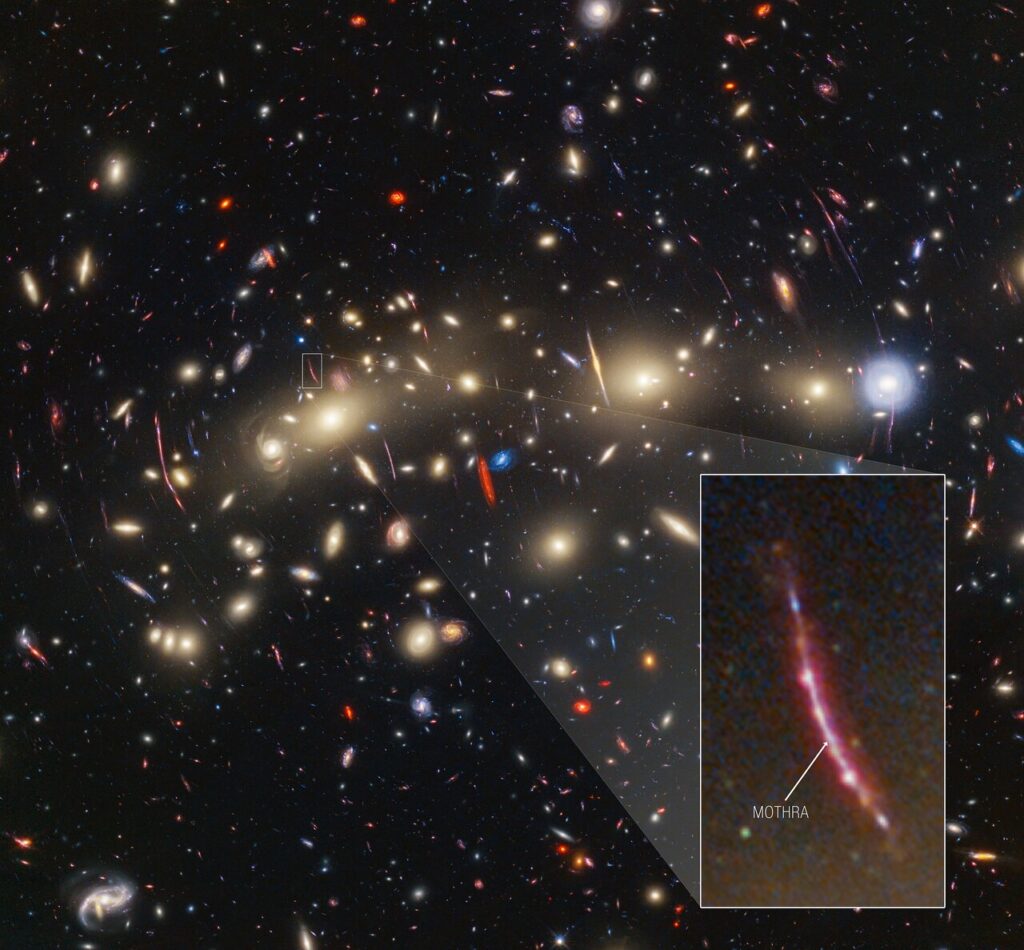
The NASA/ESA/CSA James Webb Space Telescope and the NASA/ESA Hubble Space Telescope have united to study an expansive galaxy cluster known as MACS0416. The resulting panchromatic image combines visible and infrared light to assemble one of the most comprehensive views of the Universe ever obtained. Located about 4.3 billion light-years from Earth, MACS0416 is a pair of colliding galaxy clusters that will eventually combine to form an even bigger cluster.

A field of galaxies on the black background of space. In the middle is a collection of dozens of yellowish spiral and elliptical galaxies that form a foreground galaxy cluster. Among them are distorted linear features, which mostly appear to follow invisible concentric circles curving around the centre of the image. The linear features are created when the light of a background galaxy is bent and magnified through gravitational lensing. A variety of brightly coloured, red and blue galaxies of various shapes are scattered across the image, making it feel densely populated.
This panchromatic view of galaxy cluster MACS0416 was created by combining infrared observations from the NASA/ESA/CSA James Webb Space Telescope with visible-light data from the NASA/ESA Hubble Space Telescope. To make the image, in general the shortest wavelengths of light were colour-coded blue, the longest wavelengths red, and intermediate wavelengths green. The resulting wavelength coverage, from 0.4 to 5 microns, reveals a vivid landscape of galaxies that could be described as one of the most colourful views of the universe ever created.
MACS0416 is a galaxy cluster located about 4.3 billion light-years from Earth, meaning that the light from it that we see now left the cluster shortly after the formation of our Solar System. This cluster magnifies the light from more distant background galaxies through gravitational lensing. As a result, the research team has been able to identify magnified supernovae and even very highly magnified individual stars.
Those colours give clues to galaxy distances: the bluest galaxies are relatively nearby and often show intense star formation, as best detected by Hubble, while the redder galaxies tend to be more distant, or else contain copious amounts of dust, as best detected by Webb. The image reveals a wealth of details that it is only possible to capture by combining the power of both space telescopes.
In this image, blue represents data at wavelengths of 0.435, 0.606, 0.814, and 1.05 microns (Hubble filters F435W, F606W, F814W, and F105W). Green combines data at 0.90, 1.15, 1.5, 1.6, 2.0, and 2.77 microns (Hubble filter F160W and Webb filters F090W, F115W, F150W, F200W, and F277W). Red represents data at 3.56, 4.1, and 4.44 microns (Webb filters F356W, F410M and F444W).
Credit: NASA, ESA, CSA, STScI, J. Diego (Instituto de Física de Cantabria, Spain), J. D’Silva (U. Western Australia), A. Koekemoer (STScI), J. Summers & R. Windhorst (ASU), and H. Yan (U. Missouri)

The image reveals a wealth of details that are only possible by combining the power of both space telescopes. It includes a bounty of galaxies outside the cluster and a sprinkling of sources that vary over time, likely due to gravitational lensing — the distortion and amplification of light from distant background sources.

This cluster was the first of a set of unprecedented, super-deep views of the Universe from an ambitious, collaborative Hubble programme called the Frontier Fields, inaugurated in 2014. Hubble pioneered the search for some of the intrinsically faintest and youngest galaxies ever detected. Webb’s infrared view significantly bolsters this deep look by going even farther into the early Universe with its infrared vision.

To make the image, in general the shortest wavelengths of light were colour-coded blue, the longest wavelengths red, and intermediate wavelengths green. The broad range of wavelengths, from 0.4 to 5 microns, yields a particularly vivid landscape of galaxies.

Those colours give clues to galaxy distances: the bluest galaxies are relatively nearby and often show intense star formation, as best detected by Hubble, while the redder galaxies tend to be more distant and are best detected by Webb. Some galaxies also appear very red because they contain copious amounts of cosmic dust that tends to absorb bluer colours of starlight.

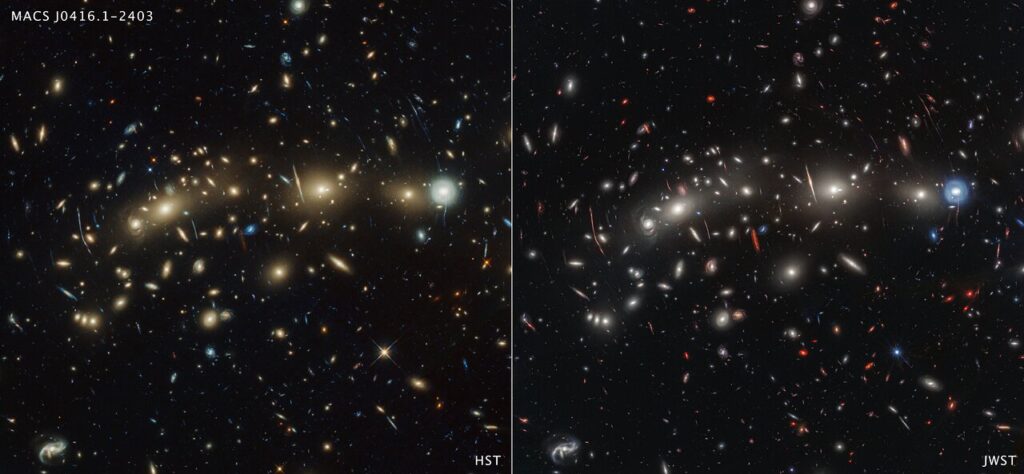
Two side-by-side photos of the same region of space. The left image is labelled “HST” and the right image “JWST.” In the middle of both, stretching from left to right, is a collection of dozens of yellowish spiral and elliptical galaxies that form a foreground galaxy cluster. A variety of galaxies of various shapes are scattered across the image, making it feel densely populated. The JWST image contains a number of red galaxies that are invisible or only barely visible in the HST image.
This side-by-side comparison of galaxy cluster MACS0416 as seen by the NASA/ESA Hubble Space Telescope in optical light (left) and the NASA/ESA/CSA James Webb Space Telescope in infrared light (right) reveals different details. Both images feature hundreds of galaxies, however the Webb image shows galaxies that are invisible or only barely visible in the Hubble image. This is because Webb’s infrared vision can detect galaxies too distant or dusty for Hubble to see. Light from distant galaxies is redshifted due to the expansion of the Universe.
Credit: NASA, ESA, CSA, STScI

While the new Webb observations contribute to this aesthetic view, they were taken for a specific scientific purpose. The research team combined their three epochs of observations, each taken weeks apart, with a fourth epoch from the CANUCS (CAnadian NIRISS Unbiased Cluster Survey) research team. The goal was to search for objects varying in observed brightness over time, known as transients.

They identified 14 such transients across the field of view. Twelve of them were located in three galaxies that are highly magnified by gravitational lensing, and they are likely to be individual stars or multiple-star systems that are briefly very highly magnified. The remaining two transients are within more moderately magnified background galaxies and are likely to be supernovae.

The finding of so many transients with observations spanning a relatively short timeframe suggests that astronomers could find many more transients in this cluster and others like it through regular monitoring with Webb.

Among the transients the team identified, one stood out in particular. Located in a galaxy that existed about 3 billion years after the Big Bang, it is magnified by a factor of at least 4000. The team nicknamed the star system Mothra in a nod to its ‘monster nature’, being both extremely bright and extremely magnified. It joins another lensed star that the researchers previously identified and that they nicknamed Godzilla. Both Godzilla and Mothra are giant monsters known as kaiju in Japanese cinema.

Interestingly, Mothra is also visible in the Hubble observations that were taken nine years earlier. This is unusual, because a very specific alignment between the foreground galaxy cluster and the background star is needed to magnify a star so greatly. The mutual motions of the star and the cluster should have eventually eliminated that alignment.

A field of galaxies on the black background of space. In the middle, stretching from left to right, is a collection of dozens of yellowish spiral and elliptical galaxies that form a foreground galaxy cluster. Among them are distorted linear features created when the light of a background galaxy is bent and magnified through gravitational lensing. At centre left, a particularly prominent example stretches vertically about three times the length of a nearby galaxy. It is outlined by a white box, and a lightly shaded wedge leads to an enlarged view at the bottom right. The linear feature is reddish and curves gently. It is studded with about a half dozen bright clumps. One such spot near the middle of the feature is labelled Mothra
This image of galaxy cluster MACS0416 highlights one particular gravitationally lensed background galaxy, which existed about 3 billion years after the big bang. That galaxy contains a transient, or object that varies in observed brightness over time, that the science team nicknamed “Mothra.” Mothra is a star that is magnified by a factor of at least 4,000 times. The team believes that Mothra is magnified not only by the gravity of galaxy cluster MACS0416, but also by an object known as a “milli-lens” that likely weighs about as much as a globular star cluster.
Credit: NASA, ESA, CSA, STScI, J. Diego (Instituto de Física de Cantabria, Spain), J. D’Silva (U. Western Australia), A. Koekemoer (STScI), J. Summers & R. Windhorst (ASU), and H. Yan (U. Missouri)

The most likely explanation is that there is an additional object within the foreground cluster that is adding more magnification. The team was able to constrain its mass to be between 10 000 and 1 million times the mass of our Sun. The exact nature of this ‘milli-lens’, however, remains unknown. It is possible that the object is a globular star cluster that’s too faint for Webb to observe directly.

The Webb data shown here were obtained as part of PEARLS (Prime Extragalactic Areas for Reionization and Lensing Science), GTO program 1176.

Webb Hubble MACS0416 Image description: A field of galaxies on the black background of space. In the middle is a collection of dozens of yellowish spiral and elliptical galaxies that form a foreground galaxy cluster. Among them are distorted linear features, which mostly appear to follow invisible concentric circles curving around the centre of the image. The linear features are created when the light of a background galaxy is bent and magnified through gravitational lensing. A variety of brightly coloured, red and blue galaxies of various shapes are scattered across the image, making it feel densely populated.
This panchromatic view of galaxy cluster MACS0416 was created by combining infrared observations from the NASA/ESA/CSA James Webb Space Telescope with visible-light data from the NASA/ESA Hubble Space Telescope. To make the image, in general the shortest wavelengths of light were colour-coded blue, the longest wavelengths red, and intermediate wavelengths green. The resulting wavelength coverage, from 0.4 to 5 microns, reveals a vivid landscape of galaxies that could be described as one of the most colourful views of the universe ever created.
MACS0416 is a galaxy cluster located about 4.3 billion light-years from Earth, meaning that the light from it that we see now left the cluster shortly after the formation of our Solar System. This cluster magnifies the light from more distant background galaxies through gravitational lensing. As a result, the research team has been able to identify magnified supernovae and even very highly magnified individual stars.
Those colours give clues to galaxy distances: the bluest galaxies are relatively nearby and often show intense star formation, as best detected by Hubble, while the redder galaxies tend to be more distant, or else contain copious amounts of dust, as best detected by Webb. The image reveals a wealth of details that it is only possible to capture by combining the power of both space telescopes.
In this image, blue represents data at wavelengths of 0.435, 0.606, 0.814, and 1.05 microns (Hubble filters F435W, F606W, F814W, and F105W). Green combines data at 0.90, 1.15, 1.5, 1.6, 2.0, and 2.77 microns (Hubble filter F160W and Webb filters F090W, F115W, F150W, F200W, and F277W). Red represents data at 3.56, 4.1, and 4.44 microns (Webb filters F356W, F410M and F444W).
Credit: NASA, ESA, CSA, STScI, J. Diego (Instituto de Física de Cantabria, Spain), J. D’Silva (U. Western Australia), A. Koekemoer (STScI), J. Summers & R. Windhorst (ASU), and H. Yan (U. Missouri)

Press release from ESA Webb.

AT2023fhn, the LFBOT nicknamed ‘the Finch’: a bizarre explosion in an unexpected place

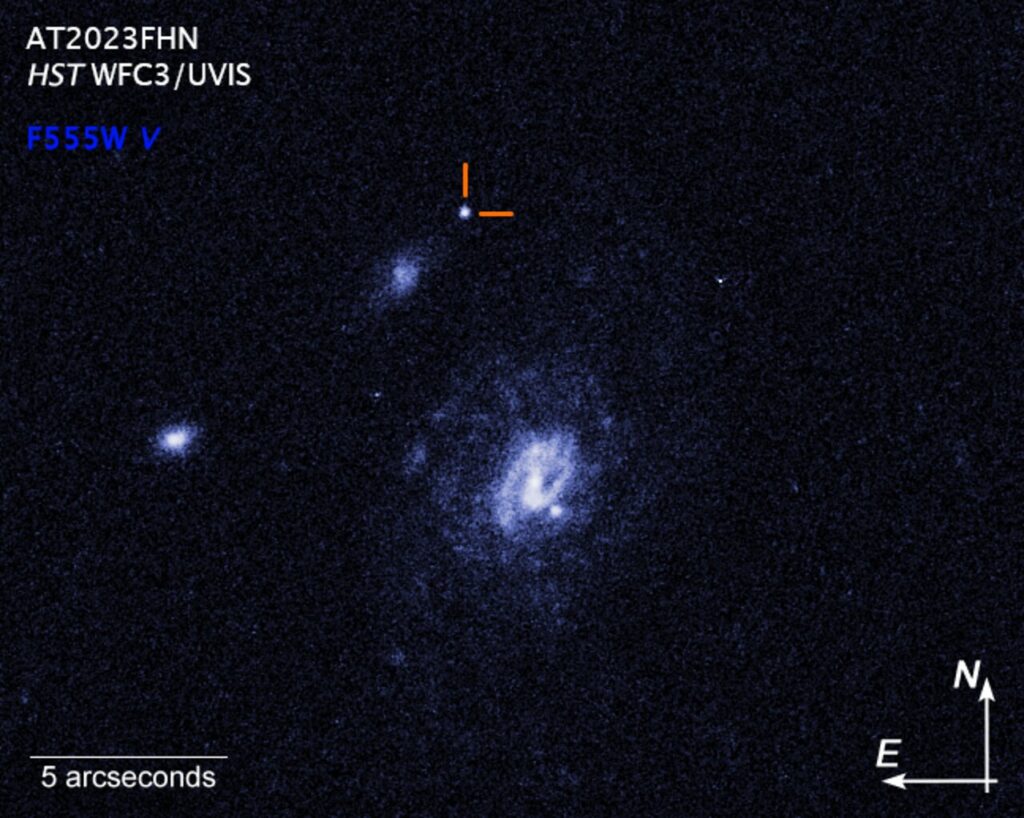
A very rare, strange burst of extraordinarily bright light in the universe just got even stranger – thanks to the eagle-eye of the NASA/ESA Hubble Space Telescope. The phenomenon, called a Luminous Fast Blue Optical Transient (LFBOT), flashed onto the scene where it wasn’t expected to be found, far away from any host galaxy. Only Hubble could pinpoint its location. The Hubble results suggest astronomers know even less about these objects than previously thought by ruling out some possible theories.

Hubble LFBOT AT2023fhn The Finch
A Hubble Space Telescope image of a Luminous Fast Blue Optical Transient (LFBOT) designated AT2023fhn, indicated by pointers. It shines intensely in blue light and evolves rapidly, reaching peak brightness and fading again in a matter of days, unlike supernovae which take weeks or months to dim. Only a handful of previous LFBOTs have been discovered since 2018. The surprise is that this latest transient, seen in 2023, lies at a large offset from both the barred spiral galaxy at right and the dwarf galaxy to the upper left. Only Hubble could pinpoint its location. And, the results are leaving astronomers even more confounded because all previous LFBOTs have been found in star-forming regions in the spiral arms of galaxies. It’s not clear what astronomical event would trigger such a blast far outside of a galaxy.
Credit: NASA, ESA, STScI, A. Chrimes (Radboud University)

Luminous Fast Blue Optical Transients (LFBOTs) are among the brightest known visible-light events in the universe – going off unexpectedly like camera flashbulbs. Only a handful have been found since the first discovery in 2018. Presently, LFBOTs are detected about once per year.

After its initial detection, the latest LFBOT was observed by multiple telescopes across the electromagnetic spectrum, from X-rays to radio waves. Only Hubble’s exquisitely sharp resolution could pinpoint its location. Designated AT2023fhn and nicknamed ‘the Finch,’ the transitory event showed all the tell-tale characteristics of an LFBOT. It shined intensely in blue light and evolved rapidly, reaching peak brightness and fading again in a matter of days, unlike supernovae which take weeks or months to dim.

But unlike any other LFBOT seen before, Hubble found that the Finch is located in apparent isolation between two neighbouring galaxies – about 50,000 light-years from a nearby spiral galaxy and about 15,000 light-years from a smaller galaxy – a baffling locale for celestial objects previously thought to exist within host galaxies.

The Hubble observations were really the crucial thing. They made us realise that this was unusual compared to the other ones like that, because without the Hubble data we would not have known,”

said Ashley Chrimes, lead author of the Hubble paper reporting the discovery in an upcoming issue of the Monthly Notices of the Royal Astronomical Society (MNRAS). He is also a European Space Agency Research Fellow, formerly of Radboud University, Nijmegen in the Netherlands.

This is an artist’s concept of one of the brightest explosions ever seen in space. Called a Luminous Fast Blue Optical Transient (LFBOT), it shines intensely in blue light and evolves rapidly, reaching peak brightness and fading again in a matter of days, unlike supernovae which take weeks or months to dim. Only a handful of previous LFBOTs have been discovered since 2018. And they all happen inside galaxies where stars are being born. But as this illustration shows, the LFBOT flash discovered in 2023 by Hubble was seen between galaxies. This only compounds the mystery of what these transient events are. Because astronomers don’t know the underlying process behind LFBOTs, the explosion shown here is purely conjecture based on some known transient phenomenon.
Credit: NASA, ESA, NSF’s NOIRLab, M. Garlick , M. Zamani

While these awesome explosions have been assumed to be a rare type of supernova (called core-collapse supernovae), the gargantuan stars that turn into supernovae are short-lived by stellar standards. Therefore, the massive progenitor stars to supernovae don’t have time to travel very far from their birthing place – a cluster of newborn stars. All previous LFBOTs have been found in the spiral arms of galaxies where star birth is ongoing.

The more we learn about LFBOTs, the more they surprise us,” said Chrimes. “We’ve now shown that LFBOTs can occur a long way from the centre of the nearest galaxy, and the location of the Finch is not what we expect for any kind of supernova.”

The Zwicky Transient Facility – an extremely wide-angle ground-based camera that scans the entire northern sky every two days – first alerted astronomers to the Finch on 10 April 2023. Once it was spotted, the researchers triggered a pre-planned program of observations that had been on standby, ready to quickly turn their attention to any potential LFBOT candidates that arose.

Spectroscopic measurements made with the Gemini South telescope in Chile found that the Finch is a scorching 20,000 degrees Celsius. Gemini also helped determine its distance from Earth so its luminosity could be calculated. Together with data from other observatories including the Chandra X-ray Observatory and the Very Large Array radio telescope, these findings confirmed the explosion was indeed an LFBOT.

The LFBOTs could be the result of stars being torn apart by an intermediate-mass black hole (between 100 to 1,000 solar masses). The NASA/ESA/CSA James Webb Space Telescope’s high resolution and infrared sensitivity might eventually be used to find that the Finch exploded inside a globular star cluster in the outer halo of one of the two neighbouring galaxies. A globular star cluster is the most likely place an intermediate-mass black hole could be found.

To explain the unusual location of the Finch, the researchers are considering the alternative possibility that it is the result of a collision of two neutron stars, travelling far outside their host galaxy, that have been spiralling toward each other for billions of years. Such collisions produce a kilonova – an explosion 1,000 times more powerful than a standard supernova. However, one very speculative theory is that if one of the neutron stars is highly magnetised – a magnetar – it could greatly amplify the power of the explosion even further to 100 times the brightness of a normal supernova.

The discovery poses many more questions than it answers,” said Chrimes. “More work is needed to figure out which of the many possible explanations is the right one.”

Because astronomical transients can pop up anywhere and at any time, and are relatively fleeting in astronomical terms, researchers rely on wide-field surveys that can continuously monitor large areas of the sky to detect them and alert other observatories like Hubble to do follow-up observations.

A larger sample is needed to converge on a better understanding of the phenomenon, say researchers. Upcoming all-sky survey telescopes may be able to detect more, depending on the underlying astrophysics.

Hubble LFBOT AT2023fhn The Finch
A Hubble Space Telescope image of a Luminous Fast Blue Optical Transient (LFBOT) designated AT2023fhn, indicated by pointers. It shines intensely in blue light and evolves rapidly, reaching peak brightness and fading again in a matter of days, unlike supernovae which take weeks or months to dim. Only a handful of previous LFBOTs have been discovered since 2018. The surprise is that this latest transient, seen in 2023, lies at a large offset from both the barred spiral galaxy at right and the dwarf galaxy to the upper left. Only Hubble could pinpoint its location. And, the results are leaving astronomers even more confounded because all previous LFBOTs have been found in star-forming regions in the spiral arms of galaxies. It’s not clear what astronomical event would trigger such a blast far outside of a galaxy.
Credit: NASA, ESA, STScI, A. Chrimes (Radboud University)

Press release from ESA Hubble.

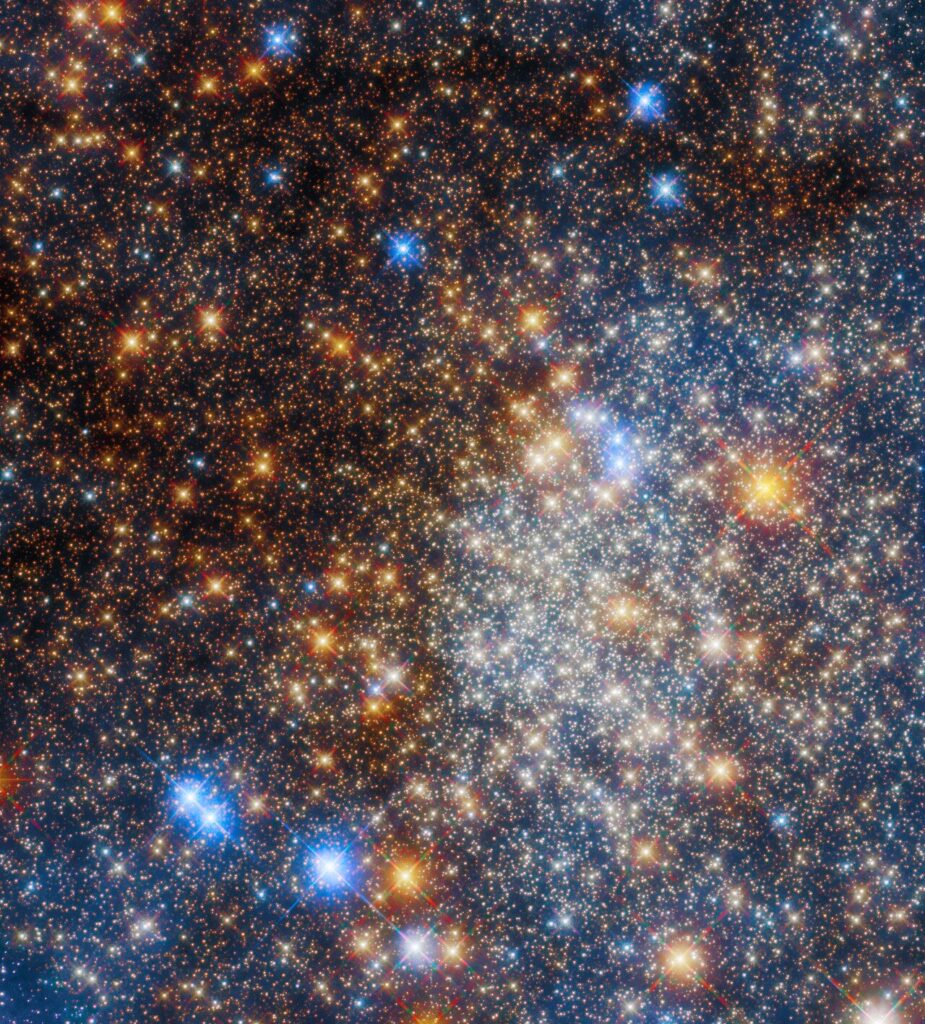
The glittering globular cluster Terzan 12 — a vast, tightly bound collection of stars — fills the frame of this image from the NASA/ESA Hubble Space Telescope. The location of this globular cluster, deep in the Milky Way galaxy in the constellation Sagittarius, means that it is shrouded in gas and dust which absorb and alter the starlight emanating from Terzan 12.

This star-studded stellar census comes from a string of observations that aim to systematically explore the relatively few globular clusters located towards the centre of our galaxy, such as Terzan 12, which is located about 15 000 light-years from Earth. Globular clusters are not uncommon in the Milky Way galaxy. Around 150 are known, mostly in its outer halo, and Hubble has revolutionised their study since its launch in 1990. However, examining clusters like Terzan 12, highly obscured by interstellar dust, is complicated by the resulting reddening of the light.

Terzan 12 Hubble
The glittering globular cluster Terzan 12 — a vast, tightly bound collection of stars — fills the frame of this image from the NASA/ESA Hubble Space Telescope. This star-studded stellar census comes from a string of observations that aim to systematically explore globular clusters located towards the centre of our galaxy, such as this one in the constellation Sagittarius. The locations of these globular clusters — deep in the Milky Way galaxy — mean that they are shrouded in gas and dust, which can block or alter the wavelengths of starlight emanating from the clusters.
Here, astronomers were able to sidestep the effect of gas and dust by comparing the new observations made with the razor-sharp vision of Hubble’s Advanced Camera for Surveys and Wide-Field Camera 3 with pre-existing images. Their observations should shed light on the relation between age and composition in the Milky Way’s innermost globular clusters.
Credit:
ESA/Hubble & NASA, R. Cohen (Rutgers University)

When starlight passes through an interstellar cloud it can be absorbed and scattered by particles of dust. The strength of this scattering depends on the wavelength of the light, with shorter wavelengths being scattered and absorbed more strongly. This means that the blue wavelengths of light from stars are less likely to make it through a cloud, making background stars appear redder than they actually are.

Astronomers refer to the colour change caused by the scattering and absorption of starlight — appropriately — as reddening, and it is responsible for the vibrant range of colours in this image. Relatively unobscured stars shine brightly in white and blue, whereas creeping tendrils of gas and dust blanket other large portions of Terzan 12, giving stars a sinister red hue. The more dust that lies along our line of sight to the cluster, the more the light of the stars is reddened.

A similar effect is responsible for the spectacular rosy hues of sunsets here on Earth. The atmosphere preferentially scatters shorter wavelengths of light, which is why the sky overhead appears blue. As the sun sinks lower in the sky, sunlight has to pass through more of the atmosphere, which means more and more blue light is scattered and sunlight takes on a characteristically golden red hue.

Some of the stars in the photo appear starkly different in colour to their near neighbours. The brightest red stars are bloated, ageing giants, many times larger than our Sun. They lie between Earth and the cluster. Only a few may actually be members of the cluster. The very brightest hot, blue stars are also along the line of sight and not inside the cluster, which only contains ageing stars.

The reddening of stars usually poses problems for astronomers, but the scientists behind this observation of Terzan 12 were able to sidestep the effect of gas and dust by comparing the new observations made with the razor-sharp vision of Hubble’s Advanced Camera for Surveys and Wide-Field Camera 3 with pre-existing images. Their observations should shed light on the relation between age and composition in the Milky Way’s galaxy’s innermost globular clusters, comparable to astronomers’ understanding of the clusters spread throughout the rest of our galaxy.

Incidentally, the Terzan clusters suffer from something of an astronomical identity crisis: there were actually only 11 clusters discovered by the Turkish-Armenian astronomer Agop Terzan. The mix-up results from an error made by Terzan in 1971, when he rediscovered Terzan 5 — a cluster he had already discovered and reported in 1968 — and named it Terzan 11. Terzan attempted to fix his mistake, but the confusion caused has persisted in scientific studies ever since, astronomers eventually settling on the odd convention that there is no Terzan 11.

Losing and then rediscovering astronomical objects is surprisingly common, even in our own Solar System. Minor planets such as asteroids and dwarf planets are often detected and then subsequently lost because their orbits cannot be determined from only a tiny handful of observations.

Terzan 12 Hubble
This composite image shows the location of the globular star cluster Terzan 12 as seen by the NASA/ESA Hubble Space Telescope.
Top: A view of a section of our Milky Way in the direction of the constellation Sagittarius. Dense clouds of dust are etched across a whitish background of stars. The object at upper right is the Rho Ophiuchi cloud complex.
Bottom left: Photo of a small portion of the Milky Way which is only one-degree across – twice the angular diameter of the full moon. The globular cluster is in the image centre.
Bottom Right: A new Hubble Space Telescope image of the dense cluster Terzan 12. Intervening dust scatters starlight to create multiple reddish hues. The brightest red stars in the photo are bloated, ageing giants, many times larger than our Sun. They lie between Earth and the cluster. Only a few may actually be members of the cluster. The very brightest hot, blue stars are also along the line of sight and not inside the cluster, which only contains ageing stars. The cluster is about 15,000 light-years from Earth.
Credit:
NASA, ESA, Stéphane Guisard, ESO, Digitized Sky Survey, ESA/Hubble, Roger Cohen (Rutgers University), Joseph DePasquale (STScI)


Press release from ESA Hubble

Hubble sees boulders escaping from asteroid Dimorphos

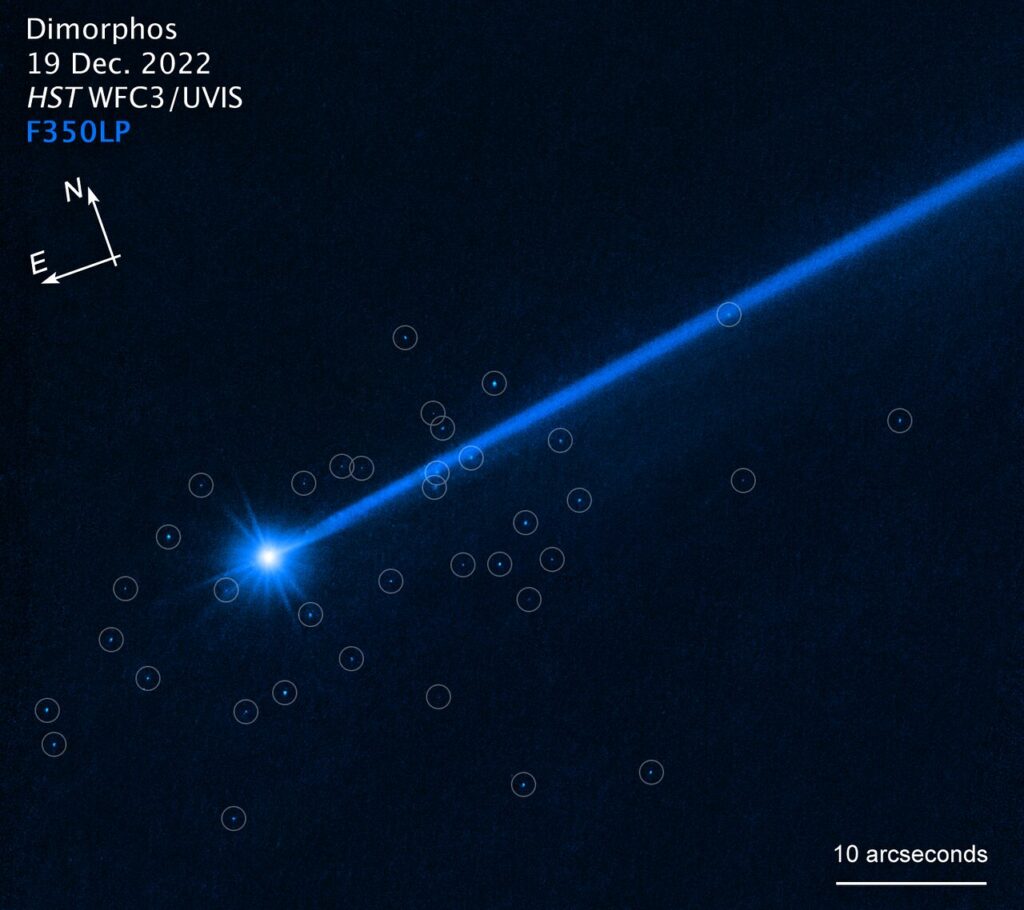
Astronomers using the NASA/ESA/ Hubble Space Telescope’s extraordinary sensitivity have discovered a swarm of boulders that were possibly shaken off the asteroid Dimorphos when NASA deliberately slammed the half-tonne DART impactor spacecraft into Dimorphos at approximately 22 500 kilometres per hour. DART intentionally impacted Dimorphos on 26 September 2022, slightly changing the trajectory of its orbit around the larger asteroid Didymos.

Hubble boulders Dimorphos The bright white object at lower left is the asteroid Dimorphos. It has a blue dust tail extending diagonally to the upper right. A cluster of blue dots surrounds the asteroid. These are boulders that were knocked off the asteroid when, on 26 September 2022, NASA deliberately slammed the half-tonne DART impactor spacecraft into the asteroid as a test of what it would take to deflect some future asteroid from hitting Earth. Hubble photographed the slow-moving boulders in December 2022
This NASA/ESA Hubble Space Telescope image of the asteroid Dimorphos was taken on 19 December 2022, nearly four months after the asteroid was impacted by NASA’s DART (Double Asteroid Redirection Test) mission. Hubble’s sensitivity reveals a few dozen boulders knocked off the asteroid by the force of the collision. These are among the faintest objects Hubble has ever photographed inside the Solar System. The ejected boulders range in size from 1 metre to 6.7 metres across, based on Hubble photometry. They are drifting away from the asteroid at around a kilometre per hour. The discovery yields invaluable insights into the behaviour of a small asteroid when it is hit by a projectile for the purpose of altering its trajectory.
Credit: NASA, ESA, D. Jewitt (UCLA)

The 37 ejected boulders range in size from 1 metre to 6.7 metres across, based on Hubble photometry. They are drifting away from the asteroid at around one kilometre per hour. The total mass in these detected boulders is about 0.1% the mass of Dimorphos. The boulders are some of the faintest objects ever imaged in the Solar System.

This opens up a new dimension for studying the aftermath of the DART experiment using the European Space Agency’s upcoming Hera mission, which is due to launch in 2024. The spacecraft will perform a detailed post-impact survey of the target asteroid Dimorphos. Hera will turn the grand-scale experiment into a well-understood and repeatable planetary defence technique that might one day be used for real [1].

The boulders are most likely not shattered pieces of the diminutive asteroid caused by the impact. They were already scattered across the asteroid’s surface, as evident in the last close-up picture taken by the DART spacecraft just two seconds before collision, when it was only 11 kilometres above the surface.

The science team that observed these boulders with Hubble estimates that the impact shook off two percent of the boulders on the asteroid’s surface. While the boulder observations by Hubble also give an estimate for the size of the DART impact crater, Hera will eventually determine the actual crater size.

Long ago, Dimorphos may have formed from material shed into space by the larger asteroid Didymos. The parent body may have spun up too quickly or could have lost material after a glancing collision with another object, among other scenarios. The ejected material formed a ring that gravitationally coalesced to form Dimorphos. This would make it a flying rubble pile of rocky debris loosely held together by the relatively weak pull of its gravity. Therefore, the interior is probably not solid, but has a structure more like a bunch of grapes.

It’s not clear how the boulders were lifted off the asteroid’s surface. They could be part of an ejecta plume that was photographed by Hubble and other observatories. Or a seismic wave from the impact may have rattled through the asteroid — like hitting a bell with a hammer — shaking loose the surface rubble.

The DART and LICIACube (Light Italian CubeSat for Imaging of Asteroids) teams have also been studying boulders detected in images taken by LICIACube’s LUKE (LICIACube Unit Key Explorer) camera in the minutes immediately following DART’s kinetic impact.

Notes

[1] Just like Hubble and the NASA/ESA/CSA James Webb Space Telescope, NASA’s DART and ESA’s Hera missions are great examples of what international collaboration can achieve; the two missions are supported by the same teams of scientists and astronomers, and operate via an international collaboration called AIDA — the Asteroid Impact and Deflection Assessment.

NASA and ESA worked together in the early 2000s to develop asteroid monitoring systems, but recognised there was a missing link in the chain between asteroid threat identification and ways of addressing that threat. In response NASA oversaw the DART mission while ESA developed the Hera mission to gather additional data on DART’s impact. With the Hera mission, ESA is assuming even greater responsibility for protecting our planet and ensuring that Europe plays a leading role in the common effort to tackle asteroid risks. As Europe’s flagship planetary defender, Hera is supported through the Agency’s Space Safety programme, part of the Operations Directorate.

The bright white object at lower left is the asteroid Dimorphos. It has a blue dust tail extending diagonally to the upper right. A cluster of blue dots surrounds the asteroid. These are boulders that were knocked off the asteroid when, on 26 September 2022, NASA deliberately slammed the half-tonne DART impactor spacecraft into the asteroid as a test of what it would take to deflect some future asteroid from hitting Earth. Hubble photographed the slow-moving boulders in December 2022
Hubble sees boulders escaping from asteroid Dimorphos: this NASA/ESA Hubble Space Telescope image of the asteroid Dimorphos was taken on 19 December 2022, nearly four months after the asteroid was impacted by NASA’s DART (Double Asteroid Redirection Test) mission. Hubble’s sensitivity reveals a few dozen boulders knocked off the asteroid by the force of the collision. These are among the faintest objects Hubble has ever photographed inside the Solar System. The ejected boulders range in size from 1 metre to 6.7 metres across, based on Hubble photometry. They are drifting away from the asteroid at around a kilometre per hour. The discovery yields invaluable insights into the behaviour of a small asteroid when it is hit by a projectile for the purpose of altering its trajectory.
Credit: NASA, ESA, D. Jewitt (UCLA)

Press release from ESA Hubble

Hubble hunts for intermediate-sized black hole close to home; the study has been published in the Monthly Notices of the Royal Astronomical Society

Astronomers using the NASA/ESA Hubble Space Telescope have come up with what they say is some of their best evidence yet for the presence of a rare class of intermediate-sized black holes, having found a strong candidate lurking at the heart of the closest globular star cluster to Earth, located 6000 light-years away.

Messier 4 M4
Hubble hunts for intermediate-sized black hole close to home. A Hubble Space Telescope image of the globular star cluster, Messier 4. The cluster is a dense collection of several hundred thousand stars. Astronomers suspect that an intermediate-mass black hole, weighing as much as 800 times the mass of our Sun, is lurking, unseen, at its core. Credit: ESA/Hubble & NASA

Like intense gravitational potholes in the fabric of space, virtually all black holes seem to come in two sizes: small and humongous. It’s estimated that our galaxy is littered with 100 million small black holes (several times the mass of our Sun) created from exploded stars. The universe at large is flooded with supermassive black holes, weighing millions or billions of times our Sun’s mass and found in the centres of galaxies.

A long-sought missing link is an intermediate-mass black hole, weighing roughly 100 to 100,000 times our Sun’s mass. How would they form, where would they hang out, and why do they seem to be so rare?

Astronomers have identified other possible intermediate-mass black holes using a variety of observational techniques. Two of the best candidates — 3XMM J215022.4-055108, which Hubble helped discover in 2020, and HLX-1, identified in 2009 — reside in the outskirts of other galaxies. Each of these possible black holes has the mass of tens of thousands of suns, and may have once been at the centres of dwarf galaxies.

Looking much closer to home, there have been a number of suspected intermediate-mass black holes detected in dense globular star clusters orbiting our Milky Way galaxy. For example, in 2008, Hubble astronomers announced the suspected presence of an intermediate-mass black hole in the globular cluster Omega Centauri. For a number of reasons, including the need for more data, these and other intermediate-mass black hole findings still remain inconclusive and do not rule out alternative theories.

Hubble’s unique capabilities have now been used to zero-in on the core of the globular star cluster Messier 4 (M4) to go black-hole hunting with higher precision than in previous searches.

“You can’t do this kind of science without Hubble,” 

said Eduardo Vitral of the Space Telescope Science Institute in Baltimore, Maryland, and formerly of the Institut d’Astrophysique de Paris (IAP, Sorbonne University) in Paris, France, lead author on a paper to be published in the Monthly Notices of the Royal Astronomical Society.

Vitral’s team has detected a possible intermediate-mass black hole of roughly 800 solar masses. The suspected object can’t be seen, but its mass is calculated by studying the motion of stars caught in its gravitational field, like bees swarming around a hive. Measuring their motion takes time, and a lot of precision. This is where Hubble accomplishes what no other present-day telescope can do. Astronomers looked at 12 years’ worth of M4 observations from Hubble, and resolved pinpoint stars.

ESA’s Gaia spacecraft also contributed to this result with scans of over 6000 stars that constrained the global shape of the cluster and its mass. Hubble’s data tend to rule out alternative theories for this object, such as a compact central cluster of unresolved stellar remnants like neutron stars, or smaller black holes swirling around each other.

“Using the latest Gaia and Hubble data, it was not possible to distinguish between a dark population of stellar remnants and a single larger point-like source,” says Vitral. “So one of the possible theories is that rather than being lots of separate small dark objects, this dark mass could be one medium-sized black hole.”

“We have good confidence that we have a very tiny region with a lot of concentrated mass. It’s about three times smaller than the densest dark mass that we had found before in other globular clusters,” he continued. “The region is more compact than what we can reproduce with numerical simulations when we take into account a collection of black holes, neutron stars, and white dwarfs segregated at the cluster’s centre. They are not able to form such a compact concentration of mass.”

A grouping of close-knit objects would be dynamically unstable. If the object isn’t a single intermediate-mass black hole, it would require an estimated 40 smaller black holes crammed into a space only one-tenth of a light-year across to produce the observed stellar motions. The consequences are that they would merge and/or be ejected in a game of interstellar pinball.

“We measure the motions of stars and their positions, and we apply physical models that try to reproduce these motions. We end up with a measurement of a dark mass extension in the cluster’s centre,” said Vitral. “The closer to the central mass, the more randomly the stars are moving. And, the greater the central mass, the faster these stellar velocities.”

Because intermediate-mass black holes in globular clusters have been so elusive, Vitral cautions, “While we cannot completely affirm that it is a central point of gravity, we can show that it is very small. It’s too tiny for us to be able to explain other than it being a single black hole. Alternatively, there might be a stellar mechanism we simply don’t know about, at least within current physics.”

“Science is rarely about discovering something new in a single moment. It’s about becoming more certain of a conclusion step by step, and this could be one step towards being sure that intermediate-mass black holes exist,” explains Gaia mission scientist Timo Prusti. “Data from Gaia Data Release 3 on the proper motion of stars in the Milky Way were essential in this study. Future Gaia Data Releases, as well as follow-up studies from the Hubble and James Webb Space Telescopes could shed further light.”


Press release from ESA Hubble